Pillow Reorientation
WT-UMI
Whole-Body Tactile UMI for Force-Supervised Humanoid Manipulation
Conference on Robot Learning (CoRL) 2026

* Equal Contribution
Whole-Body Tactile UMI for Force-Supervised Humanoid Manipulation
Conference on Robot Learning (CoRL) 2026
* Equal Contribution
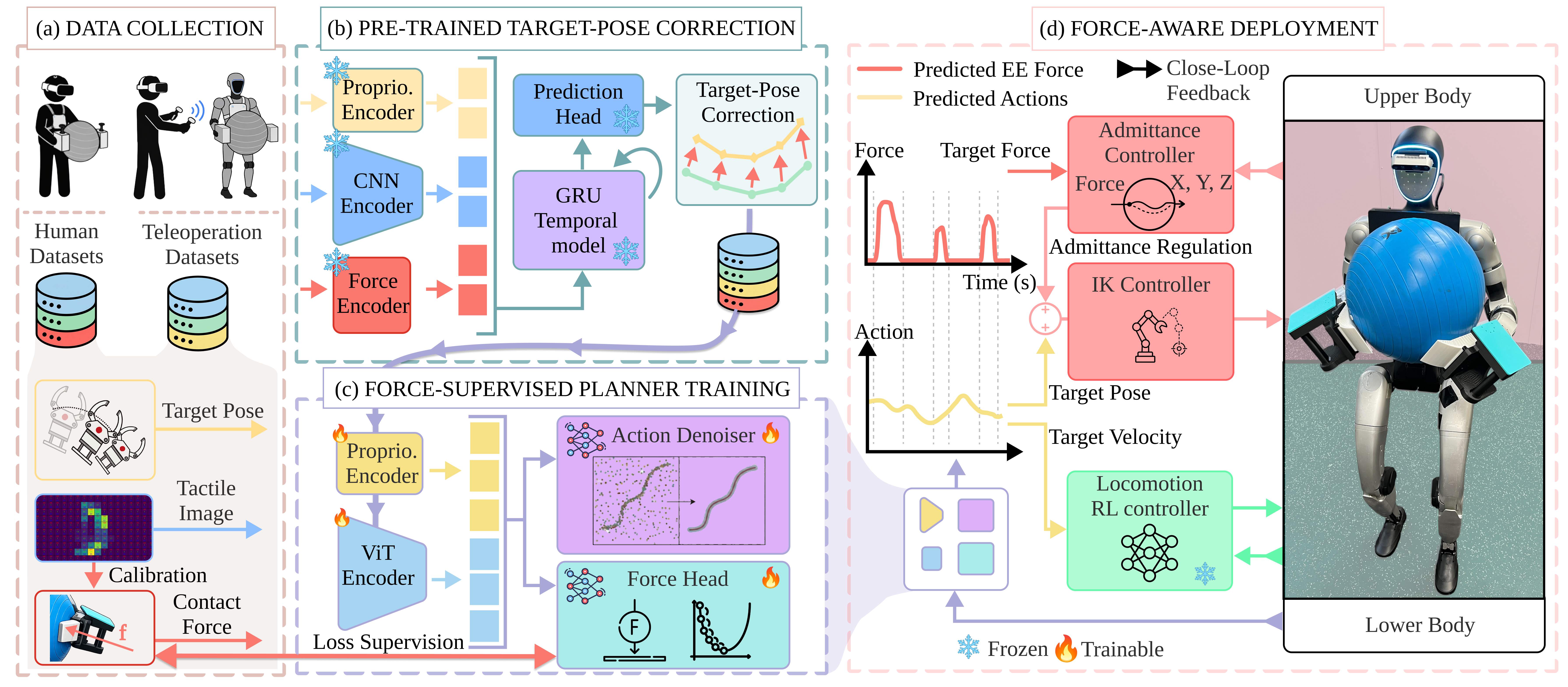
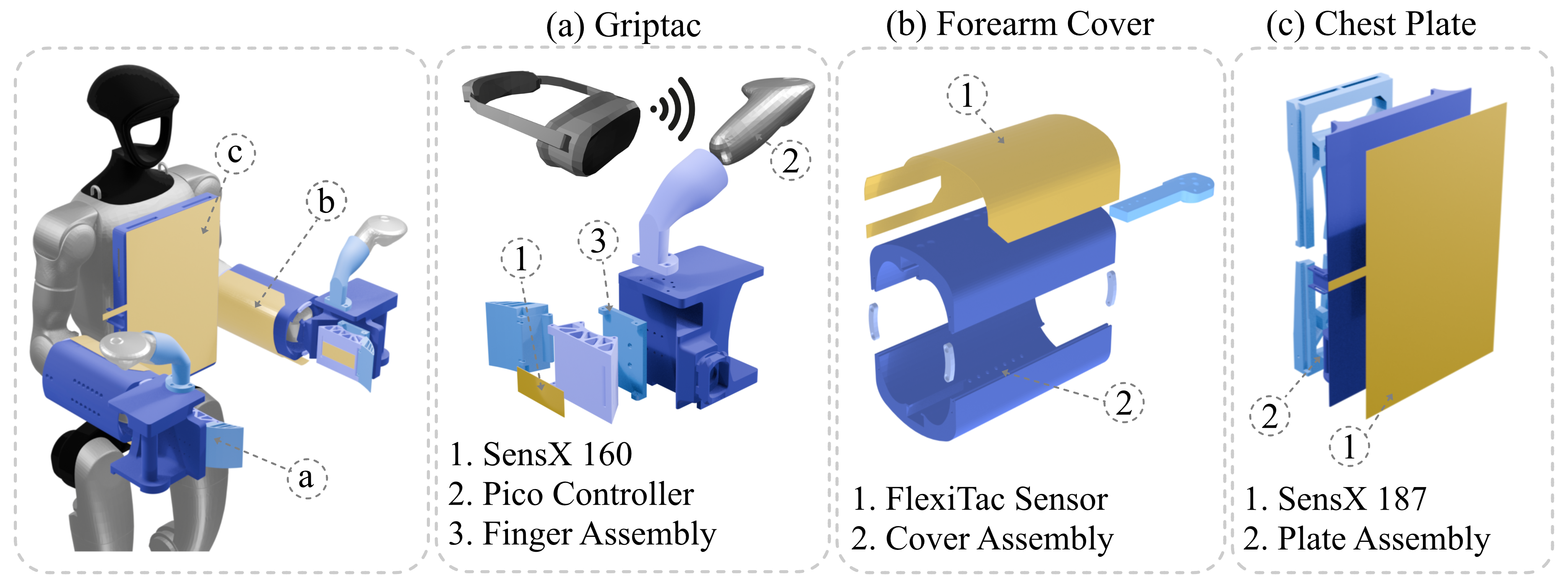
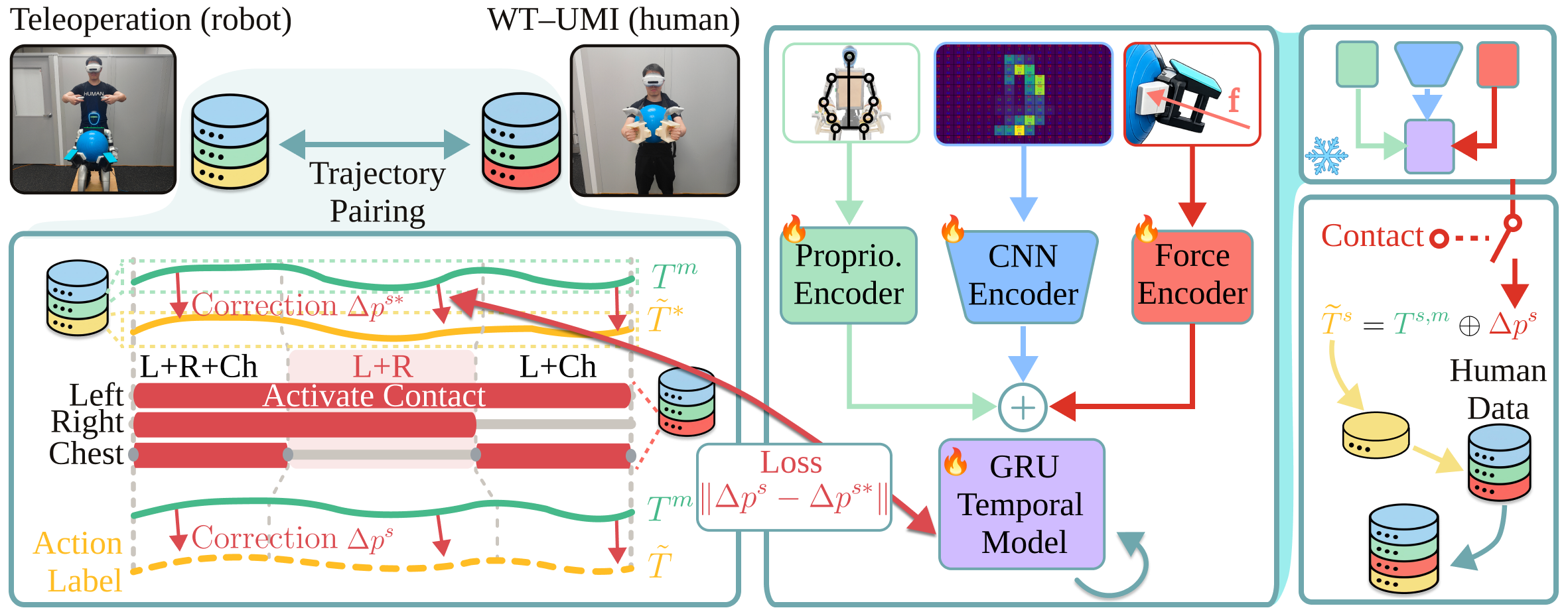
Whole-body humanoid manipulation of bulky, deformable, and shared-load objects requires distributed contact sensing and explicit force regulation, yet most imitation policies treat contact force only implicitly. On the other hand, different demonstration sources provide complementary modalities with inherent trade-offs: human demonstrations capture natural contact forces but not robot-executable actions, while teleoperation directly records robot actions but with less natural force regulation. This paper presents WT-UMI, a wearable whole-body tactile interface worn by human operators or mounted on humanoids, providing accurate observations of tactile images, contact forces, and end-effector poses across both human demonstration and humanoid teleoperation modes. We introduce a force-conditioned target-pose correction module that converts measured human poses into contact-aware robot targets by learning corrections from teleoperation data. To leverage the natural force interaction in human data, we propose a force-supervised planner that predicts end-effector pose chunks and contact-force trajectories. The predicted contact force serves as the reference for a tactile-based admittance controller. Across five contact-rich tasks spanning deformable objects, bulky rigid objects, and human–humanoid collaboration, WT-UMI improves success rate and reduces contact-position tracking error over four policy baselines.
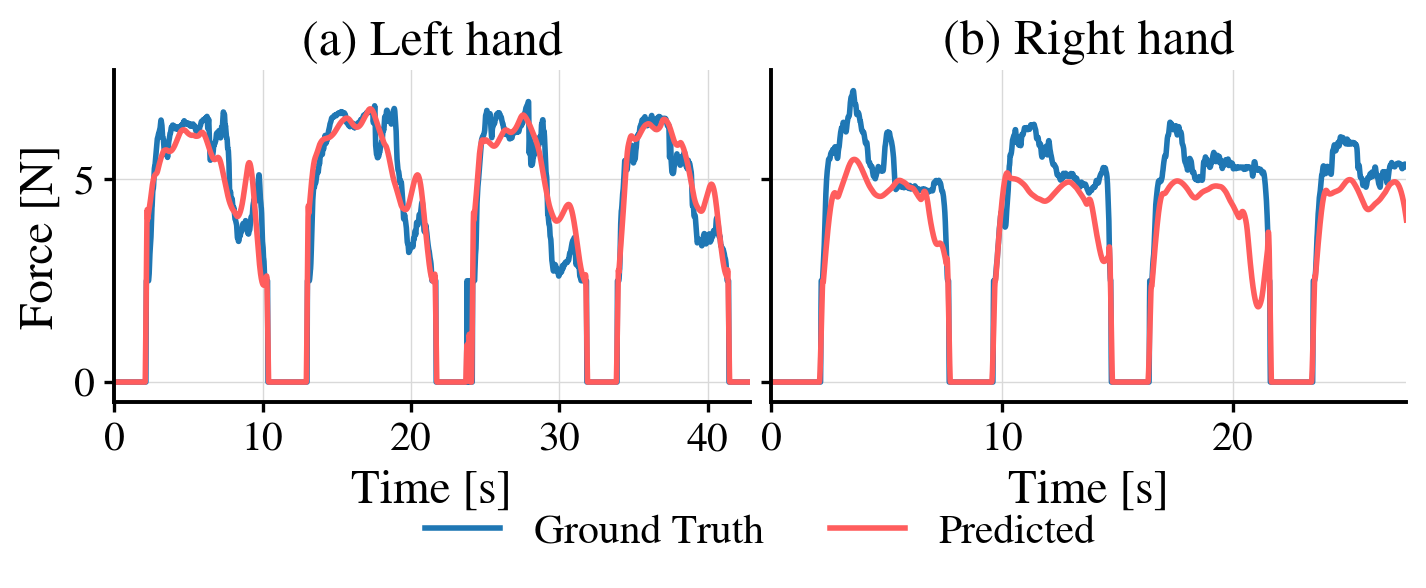
| Source | Force RMSE [N] | Lag [ms] | Force Rate RMS [N/s] | |
|---|---|---|---|---|
| Measured | Predicted | |||
| Human | 1.05 | 68 | 5.86 | 3.74 |
| Teleoperation | 2.07 | 151 | 30.62 | 19.80 |
Force signal quality. Human demonstrations exhibit more accurate and smoother force profiles than teleoperation, improving the quality of supervision for learning.
| Task | Succ. (%) | Cont. Drift (mm) | Cont. Force (N) | Translational Smoothness (m/s2) ↓ | Rotational Smoothness (rad/s2) ↓ | |||||
|---|---|---|---|---|---|---|---|---|---|---|
| Data → | Tel. | Comb. | Tel. | Comb. | Tel. | Comb. | Tel. | Comb. | Tel. | Comb. |
| T1 | 100.0 | 100.0 | 20.41 | 18.12 | 3.27 | 4.77 | 4.08 | 3.14 | 22.93 | 20.29 |
| T2 | 100.0 | 100.0 | 24.61 | 21.04 | 0.17 | 0.52 | 6.03 | 1.87 | 34.54 | 12.63 |
| T3 | 60.0 | 80.0 | 26.01 | 25.00 | 0.66 | 0.96 | 3.49 | 1.85 | 27.82 | 14.05 |
Effect of data source over tasks T1–T3. Best values are highlighted in bold.
| Policy | Task | Succ. Rate (%) ↑ | Cont. Drift (mm) ↓ | Cont. Force (N) | Translational Smoothness (m/s2) ↓ | Rotational Smoothness (rad/s2) ↓ | |||||
|---|---|---|---|---|---|---|---|---|---|---|---|
| Admi. (Ours) → | w/o | w/ | w/o | w/ | w/o | w/ | w/o | w/ | w/o | w/ | |
| ViT-FMT | T1 | 100 | 100 | 18.12 | 15.67 | 4.77 | 5.50 | 3.14 | 2.98 | 20.29 | 18.56 |
| T2 | 100 | 100 | 21.04 | 19.44 | 0.52 | 0.13 | 1.87 | 1.95 | 12.63 | 13.61 | |
| T3 | 80 | 92 | 25.00 | 22.08 | 0.96 | 1.61 | 1.85 | 1.29 | 14.05 | 10.38 | |
| ViT-DiT | T1 | 52 | 52 | 21.79 | 18.00 | 2.21 | 2.57 | 2.92 | 2.54 | 18.73 | 14.97 |
| T2 | 100 | 100 | 21.22 | 19.61 | 0.19 | 0.76 | 4.67 | 2.41 | 25.93 | 15.17 | |
| T3 | 52 | 52 | 26.22 | 22.20 | 1.74 | 0.93 | 2.33 | 2.05 | 16.47 | 14.79 | |
| π0.5 | T1 | 88 | 92 | 21.51 | 11.78 | 2.53 | 2.80 | 4.69 | 4.82 | 29.33 | 29.79 |
| T2 | 68 | 76 | 19.78 | 15.97 | 0.50 | 0.50 | 5.06 | 5.03 | 31.86 | 31.22 | |
| T3 | 84 | 76 | 20.18 | 19.40 | 2.57 | 3.38 | 4.11 | 3.53 | 27.26 | 23.56 | |
| Ψ0 | T1 | 88 | 92 | 15.80 | 13.56 | 3.14 | 3.03 | 4.20 | 3.27 | 27.06 | 23.01 |
| T2 | 89 | 96 | 20.48 | 18.69 | 2.50 | 2.50 | 4.94 | 5.44 | 32.12 | 33.04 | |
| T3 | 0 | 0 | – | – | – | – | – | – | – | – | |
Admittance ablation across all policy backbones over tasks T1 (Yogaball), T2 (Pillow), and T3 (Bucket). Each metric is evaluated without (w/o) and with (w/) our admittance control. The better or tied value is bolded for success rate, contact drift, and motion smoothness.
@inproceedings{jang2026wtumi,
  title={{WT-UMI}: Tactile-based Whole-Body Manipulation via Force-Supervised Contact-Aware Planning},
  author={Jang, Jaehwi and Gu, Zhaoyuan and Cueva, Alfred and Chai, Zimeng and Sheng, Junjie and Nguyen, Thong and Galundia, Himank and Wu, Yifan and Xue, Huishu and Legene, Isaac and Mediratta, Ojas and Doan, Davin and Collins, Andrew and Sadegh, Sarah and Kim, KyoungMok and Dhalbisoi, Rishita and Chen, Zun and Zhao, Ye},
  booktitle={Proceedings of the 10th Conference on Robot Learning},
  year={2026}
}